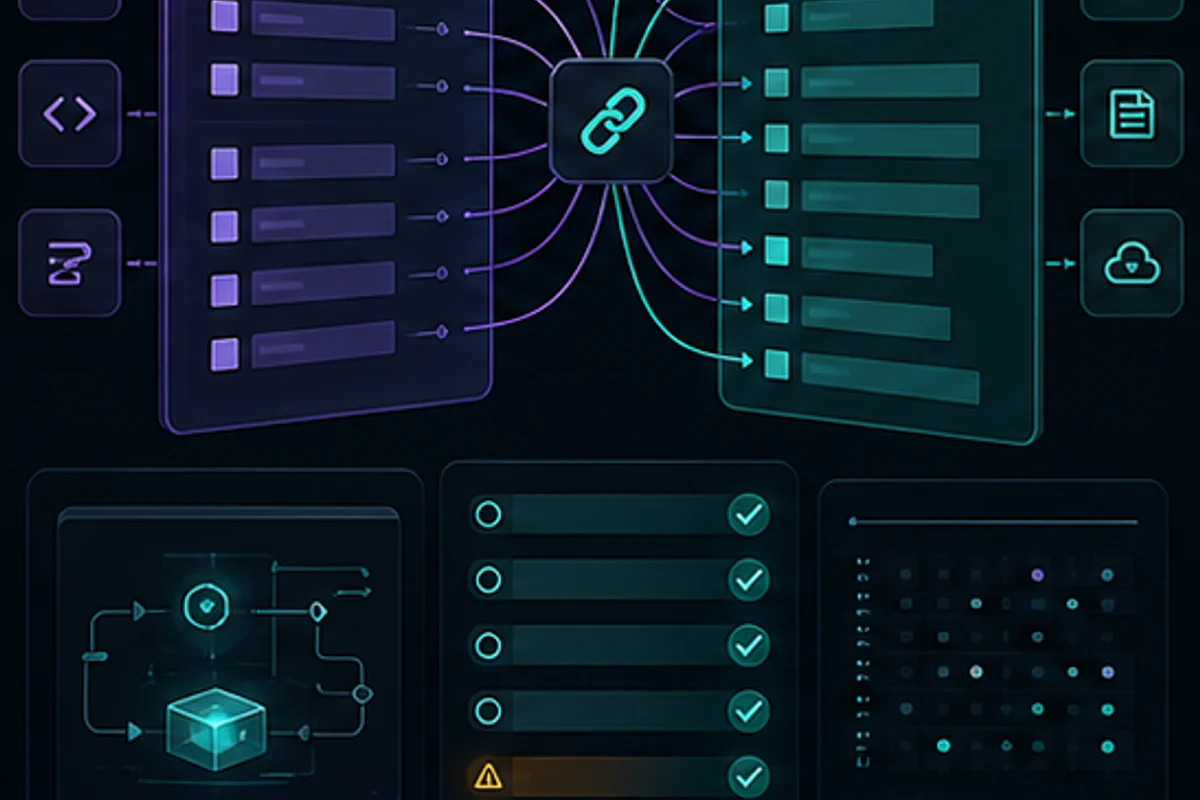
Make identifiers, meanings, validation, ownership and change behaviour explicit before connecting systems. This independent AutomaNexa guide addresses API contract design, semantic mapping and integration boundaries. It contains no paid placement, external commercial link, fabricated test, invented price or universal promise. Its purpose is to help a reader build a dated, explainable decision from evidence that can be checked again.
Define the decision before collecting options
Describe the business event, source of truth, request, response, identity, error, version and data mapping using representative examples and adverse cases. Write the decision as a question with a named audience, an accountable owner, a time horizon and a consequence if the choice is wrong. For Define an API contract and field mapping before integration, distinguish what must be true at launch from what would merely be useful later.
Describe the real context for API contract design, semantic mapping and integration boundaries: who will use the result, where it will be used, which constraints cannot move and which assumptions still require proof. Include one normal journey, one edge case and one interrupted journey so a polished demonstration cannot hide operational gaps.
Build an evidence register for this subject
Create a small register for Define an API contract and field mapping before integration with the claim being evaluated, its primary source, the date checked, the relevant market and the person responsible for rechecking it. Separate documented facts, direct observations, estimates and unanswered questions; they do not carry the same confidence.
When evidence for API contract design, semantic mapping and integration boundaries depends on a contract, regulation, price, service capability, material specification or regional practice, obtain a current authoritative source before publication or purchase. Keep private source records in AffiliaOS while the public guide explains the durable method and its limits.
Criteria that materially change the decision
Semantic identity
Confirm that similarly named fields carry the same meaning, unit, precision and lifecycle. For “Define an API contract and field mapping before integration”, record the evidence source, date, owner and exception that applies to this criterion. Then test it in one ordinary case and one adverse case. Criterion 1 should change the decision when the evidence changes; otherwise it is decoration rather than a useful control.
Record identity
Define stable keys, correlation identifiers, merge rules and duplicate handling. For “Define an API contract and field mapping before integration”, record the evidence source, date, owner and exception that applies to this criterion. Then test it in one ordinary case and one adverse case. Criterion 2 should change the decision when the evidence changes; otherwise it is decoration rather than a useful control.
Validation
Distinguish required, optional, unknown, malformed and future fields with clear failure behaviour. For “Define an API contract and field mapping before integration”, record the evidence source, date, owner and exception that applies to this criterion. Then test it in one ordinary case and one adverse case. Criterion 3 should change the decision when the evidence changes; otherwise it is decoration rather than a useful control.
Contract change
Set versioning, compatibility, deprecation, consumer notice and regression-test responsibilities. For “Define an API contract and field mapping before integration”, record the evidence source, date, owner and exception that applies to this criterion. Then test it in one ordinary case and one adverse case. Criterion 4 should change the decision when the evidence changes; otherwise it is decoration rather than a useful control.
Evidence and privacy
Keep diagnostic context while minimising sensitive payloads and unauthorised retention. For “Define an API contract and field mapping before integration”, record the evidence source, date, owner and exception that applies to this criterion. Then test it in one ordinary case and one adverse case. Criterion 5 should change the decision when the evidence changes; otherwise it is decoration rather than a useful control.
Run a representative trial, sample or walkthrough
Turn Define an API contract and field mapping before integration into the smallest complete trial that can expose an important mistake. Use representative people, devices, products, records or destinations as the subject requires. Preserve the setup, observations and limitations, and do not describe a documentary review as a hands-on test.
Ask a second person to follow the API contract design, semantic mapping and integration boundaries procedure without coaching. Record confusion, missing information, workarounds, waiting time, defects and recovery effort. A useful trial produces evidence for a decision; it is not a staged success and it does not convert one result into a market-wide claim.
Account for cost, effort and reversibility
For Define an API contract and field mapping before integration, calculate more than the headline price. Include setup, learning, recurring work, support, integration, accessibility, quality control, failure handling, switching and retirement where relevant. Use current inputs and ranges, and state clearly which figures remain estimates.
Define a reversible route for API contract design, semantic mapping and integration boundaries: what can be exported, replaced, refunded, restored, paused or handled manually; who may trigger that route; and what evidence shows it worked. A theoretical exit is not protection until its steps, permissions and dependencies have been checked.
Adapt the method to market and audience
Review Define an API contract and field mapping before integration separately for every intended edition. Language is only one layer: units, currency, tax treatment, consumer expectations, availability, delivery, privacy, accessibility and legal duties may change the decision. Obtain competent local review for regulated or consequential claims.
Write explanations for the reader who must act on API contract design, semantic mapping and integration boundaries, not for an internal expert. Expand abbreviations, use meaningful headings, preserve keyboard and mobile access, provide useful alternative text and state uncertainty directly. Accessibility findings belong in the main decision record, not in a final cosmetic check.
Risk signals that require stronger proof
- Field names are mapped without testing their business meaning. Treat this as risk signal 1 for Define an API contract and field mapping before integration: pause the affected step, identify the missing evidence or owner and define a safer fallback before continuing.
- The connector cannot distinguish create from replay. Treat this as risk signal 2 for Define an API contract and field mapping before integration: pause the affected step, identify the missing evidence or owner and define a safer fallback before continuing.
- A provider change reaches production without contract tests. Treat this as risk signal 3 for Define an API contract and field mapping before integration: pause the affected step, identify the missing evidence or owner and define a safer fallback before continuing.
These signals do not prove that an option is bad. In the context of Define an API contract and field mapping before integration, they show that the current evidence is too weak for the proposed exposure. Narrow the scope, obtain a better source, repeat the trial or choose a safer route before the cost of correction grows.
Release progressively and schedule review
Apply the conclusion from Define an API contract and field mapping before integration to a bounded audience or workload first. Define the expected outcome, adverse signals, decision owner, support route and stop condition. Compare the result with the evidence register, then correct the method before extending it.
Set the next review of API contract design, semantic mapping and integration boundaries from meaningful change triggers: a new product or supplier, revised terms, a material price change, an incident, a regulatory update, a changed audience or evidence that contradicts the original assumption. Keep corrections and retired advice traceable instead of manufacturing freshness.
Use the AutomaNexa decision checklist
- State the decision, audience, owner and consequence.
- Separate mandatory constraints from preferences.
- Register sources, observations, estimates and unknowns.
- Evaluate each subject-specific criterion independently.
- Run a representative normal and adverse journey.
- Calculate complete effort, risk and exit cost.
- Release within guardrails and schedule a dated review.
A mature conclusion for Define an API contract and field mapping before integration can be explained without hype: this route suits this audience under these constraints, is supported by this dated evidence, assigns these responsibilities and can be changed through this tested fallback.